
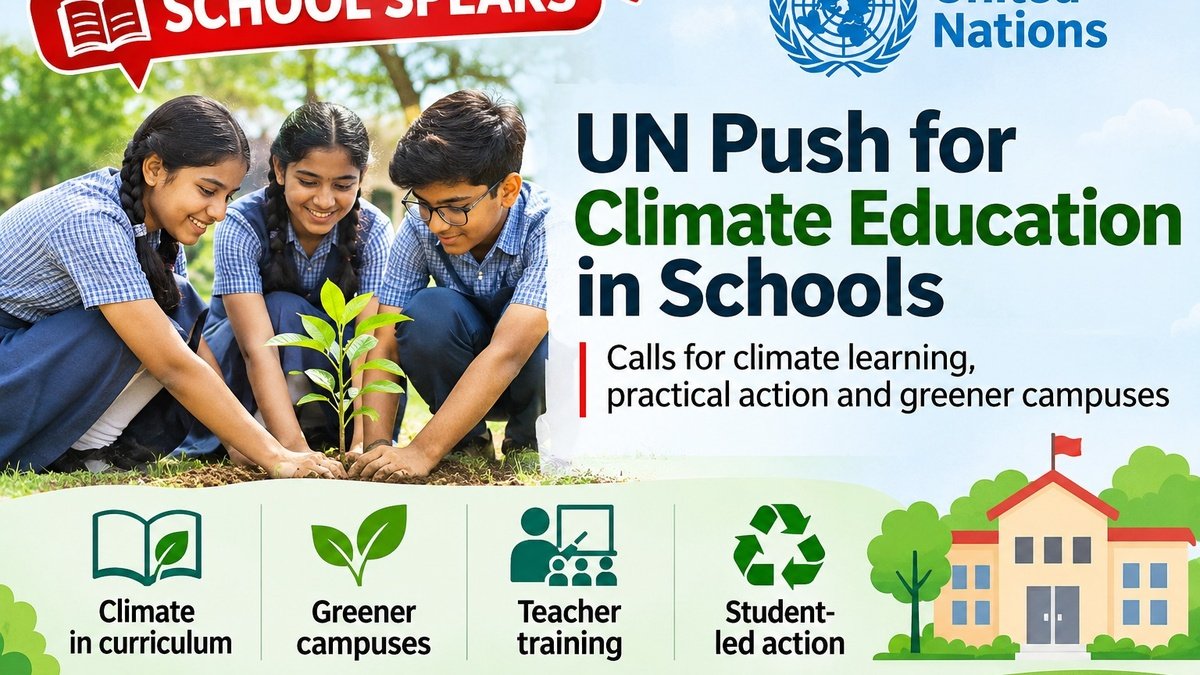
UN push puts climate education in focus, schools urged to go beyond textbooks
Jaipur: From understanding extreme weather to conserving water and auditing their school’s environmental footprint, students may need to do more than learn about climate change in textbooks. A United Nations-backed global initiative is pushing countries to integrate climate education into school curricula, teacher training and campus practices, with the aim of preparing children to respond to a warming planet.
The United Nations Educational, Scientific and Cultural Organization (UNESCO), through its Greening Education Partnership, is working towards a target of ensuring that 90% of countries include climate change in their national curricula by 2030. Its guidance recommends age-appropriate learning that combines scientific knowledge with practical action, environmental awareness and climate justice.
For India, the push comes as environmental education is already part of the school curriculum. The National Curriculum Framework for School Education 2023 recommends teaching environmental education as an interdisciplinary subject, connecting issues such as climate change, pollution and biodiversity with students’ everyday lives. The Union education ministry has also said environmental concerns are incorporated across school subjects.
The challenge is to translate classroom learning into action. Schools could introduce annual green campus audits to measure water and electricity consumption, waste generation, tree cover and plastic use. Students could track changes over time, identify areas for improvement and work with school management to adopt more sustainable practices.
Such exercises would make climate education practical rather than purely theoretical. In water-stressed regions such as Rajasthan, students could examine rainwater harvesting, groundwater conservation and traditional water-management systems. Activities could also include waste segregation, biodiversity mapping, plantation drives and energy-saving campaigns.
UNESCO’s approach emphasises four areas: greener schools, climate-focused curricula, teacher training and community engagement. Its guidance also calls for education that equips learners with the knowledge, skills and motivation to respond to environmental challenges.
India has existing mechanisms that could support this transition. The education ministry has identified school eco-clubs and activity-based learning as platforms for developing environmental awareness and practical skills among students.
For Rajasthan, the next step could be to assess how effectively climate education is being implemented in schools, whether teachers receive adequate training and whether campuses regularly monitor their environmental performance.
The broader objective is to prepare students not only to understand climate change but also to participate in addressing it. Linking lessons to measurable action could help schools become laboratories for sustainability, while giving children a practical understanding of the environmental challenges facing their communities.