
How early should parents talk to children about safe touch?
A Rajasthan study highlights gaps in children’s understanding of personal safety, underlining the need for parents and schools to start conversations about consent, bodily boundaries and online grooming early.
Jaipur: For many parents, talking to young children about safe and unsafe touch is uncomfortable, and the conversation is often postponed until they are older. But delaying it can leave children without the words to recognise inappropriate behaviour or the confidence to seek help.
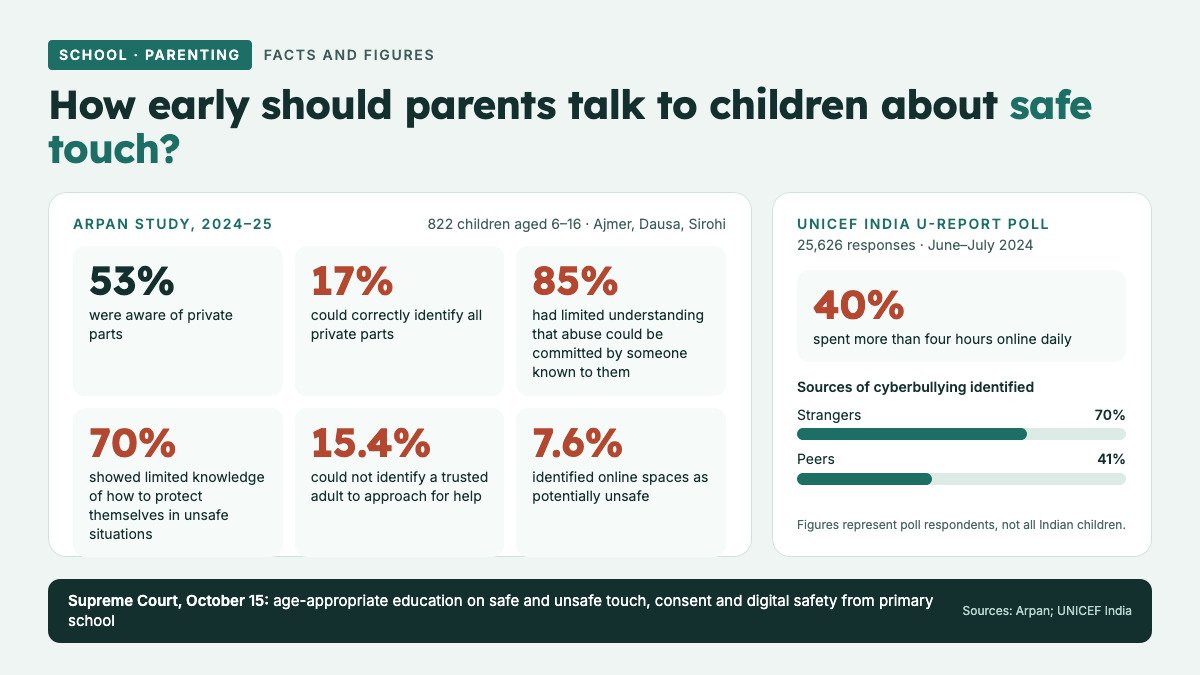
A 2024–25 study by child-protection organisation Arpan, conducted among 822 children aged six to 16 in Ajmer, Dausa and Sirohi, highlights these gaps. While 53% of children surveyed were aware of private parts, only 17% could correctly identify all of them. As many as 85% had a limited understanding that abuse could be committed by someone known to them. Only 7.6% identified online spaces as potentially unsafe, while 70% showed limited knowledge of how to protect themselves in unsafe situations. The study also found that 15.4% could not identify a trusted adult they could approach for help.
The findings underline why child-safety education cannot be limited to warnings about strangers.
The issue has gained attention following the Supreme Court’s October 15 directions calling for age-appropriate education on children’s bodies, safe and unsafe touch, and consent from the primary school stage. The court also called for digital safety and age-appropriate sex education to be incorporated into school curricula, alongside training for teachers and awareness programmes for parents.
Start with everyday conversations
For parents, the first conversation need not be a formal discussion about sexual abuse. It can begin with everyday lessons about personal space, privacy and the right to say no when an interaction makes a child uncomfortable.
Children should learn the correct names for body parts, understand that certain parts of their bodies are private and know they can approach a trusted adult if someone touches them inappropriately or asks them to keep an uncomfortable interaction secret.
Respecting children’s boundaries in ordinary family situations is equally important. If a child does not want to hug or kiss a relative, parents should avoid forcing the interaction. Such everyday experiences teach children that their feelings and personal boundaries deserve respect.
The threat may not be a stranger
The Arpan study’s finding that 85% of surveyed children had limited understanding of the possibility of abuse by someone they knew highlights a major challenge.
Parents need to explain that inappropriate behaviour is unacceptable regardless of whether it comes from a relative, neighbour, family friend or stranger. Children should also know that they will not be blamed for reporting something troubling.
When a child speaks up, adults should listen calmly, reassure them and take the disclosure seriously rather than reacting with anger or embarrassment.
Extending safety lessons online
Child safety now extends beyond homes, playgrounds and school buses. Children may encounter inappropriate requests through online games, messaging applications and social media.
A UNICEF India online-safety poll collected 25,626 responses through its U-Report platform in June and July 2024. Forty per cent of respondents said they spent more than four hours online daily. The poll also identified strangers and peers as sources of cyberbullying, at 70% and 41% respectively. These figures represent the poll’s respondents, not all Indian children.
Parents should discuss the risks of sharing private photographs or personal information, responding to suspicious messages and keeping online interactions secret. Children must feel comfortable reporting uncomfortable online experiences without immediately fearing punishment or losing access to their devices.
Schools, too, have a role in reinforcing these lessons through age-appropriate teaching, trained staff and clear reporting procedures.
Safe-touch education is not about making children fearful. It is about giving them the language to describe an uncomfortable experience, the confidence to set boundaries and the assurance that an adult will listen when they need help.

